Begin June I participated in the conference ‘The Datafied Web’, the 6th RESAW Conference in Siegen (see the program here https://www.mediacoop.uni-siegen.de/datafiedweb/program/). I gave two presentations that both emerge from my project about the history of the Danish web in the 1990s: “Establishing which websites constituted a national web in the 1990s”, and “The early datafied web: Visitor counters on the Danish web in the 1990s”.
The aim of the presentation “Establishing which websites constituted a national web in the 1990s” was “to develop, test and discuss methods to identifying Danish websites of the 1990s; and to provide new knowledge about which websites constituted the Danish web in the 1990s, by using the developed methods”. Based on the claim that URLs are pivotal in the proposed method, so to say a master key to help identify the perimeter of what constitutes ‘a national web’, I described some of the major challenges related to this — mainly that there exist(s/ed) no comprehensive overview of the Danish web of the 1990s, neither today, nor in the past — and I also highlighted how this challenge could be overcome, namely by reconstructing and patching bits and pieces from various sources. The sources that can help us reconstruct which websites constituted ‘the Danish web’ in the 1990s are: Print media, newsgroups, and similar; today’s administrator of the .dk Top-Level Domain; previous administrators of the .dk domain; websites from previous administrators of the .dk domain as found in the Internet Archive; .dk domain names found in the Internet Archive; outgoing links from .dk domain names found in the Internet Archive; web hotels (commercial/non-commercial; web hotels found in the Internet Archive; web hotels outside .dk.
One of the major insights in my work with reconstructing which websites constituted the Danish web in the 1990s was that in contrast to what I had myself done in previous studies studying only domain names on .dk was not sufficient. If we want to identify all the websites on the Danish web in the 1990s (or in general) the domain name is not enough, because every segment of a URL may be identical to an individual website in its own right. In some cases a domain name is identical to a website, but it can also be the host of an array of websites, each with their unique URL (a subdomain name or a folder name (or both)), as illustrated with an example from the Danish web in the 1990s of how URL, website, domain, and subdomains can be entangled — from Dec 1996.
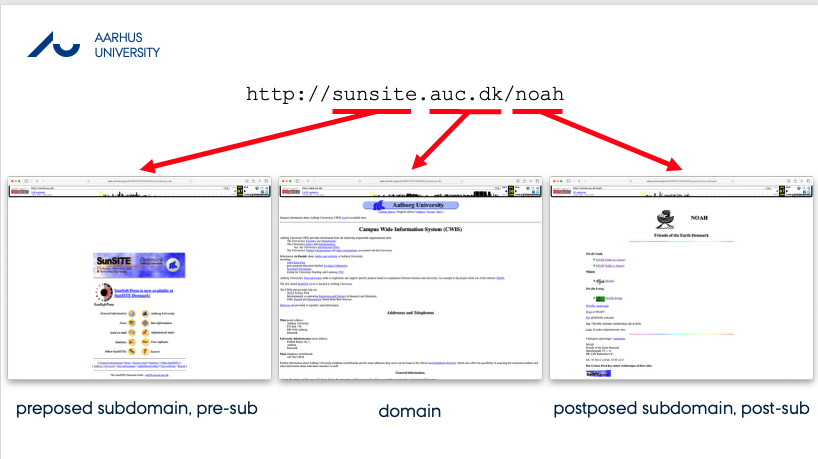
In the web address ‘sunset.auc.dk/noah’ ‘auc.dk’ is the domain name and also a website in its own right, ‘sunset.auc.dk’ constitutes a website in its own right, and the same is the case with ‘/noah’ — in this example three websites sits on the same domain name, but if we focused exclusively on characterising a national web by its domain names two of these individual websites would not be included.
As you may have noticed on the present website I have included a visitor counter on the front page which was a commonly used feature on the early web. These visitor counters were the topic of my second presentation “The early datafied web: Visitor counters on the Danish web in the 1990s”. The aim was to investigate “What role(s) did visitor counters play as one of the early web’s fundamental infrastructure elements?” by looking at their producers (companies, economy, market), technology, statistics, network, and website owners, use forms, and aesthetics.
The function of visitor counters are part of a wider navigation ecology, and they constitute one of the earliest ways of datafying the web, and they were the only way that a website holder could get automatic feedback information from and about visitors. Visitor counters were part of a two way communication: (a) they gave the website owner a sense of how popular the website was, (b) they flagged this information for the visitors of the website so that they could get a sense of the popularity of the website they visited.
One of the challenges when studying visitor counters at scale is (1) to find out how they worked technically speaking at different points in time, and (2) how to identify them in a way that can enable automated search for them, given the size of the data. The slide below explains how I approached this challenge.
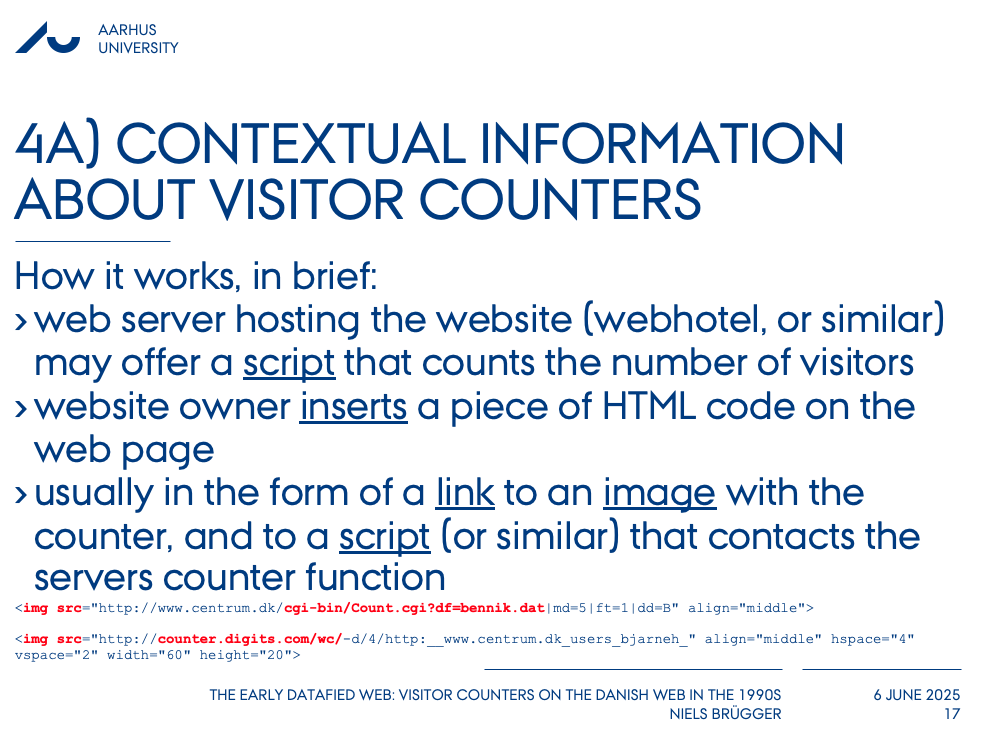
Based on this technical insight I could search all web pages within a given period for the pieces of HTML text highlighted in red above.
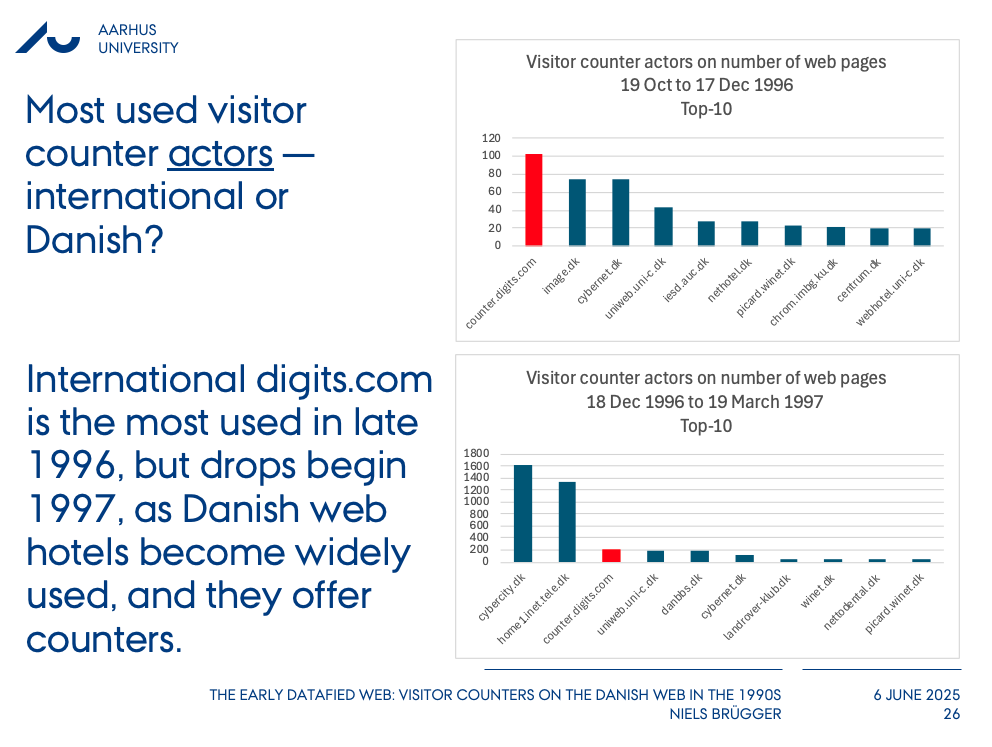
Unfortunately I didn’t have enough time to make the analysis for more than two limited and very early periods of time, namely 19 Oct-17 dec 1996, and 18 Dec 1996-19 March 1997. This analysis showed, that in the first of these periode most visitor counters were from Danish vendors, but the mostly used was the US based counter.digits.com, whereas in the second period cybercity.dk and tele.dk, two Danish web service providers had taken over in providing visitor counters to Danish web users, probably because they both offered a web hotel service where the visitor counter was one of the features that were offered.
This latter presentation will be turned into an academic article to be published in the international journal Internet Histories in 2026.
Leave a Reply